
Brian Henderson | February 7, 2026
There is a familiar argument circulating in radio that the medium “respects your time” by staying out of the way. According to this view, radio assumes people are busy living their lives, so it does not demand clicks, views, or constant interaction. Instead, it accompanies listeners while they work, drive, and move through the day.
At first glance, that framing sounds respectful. However, it collapses once listening ends.
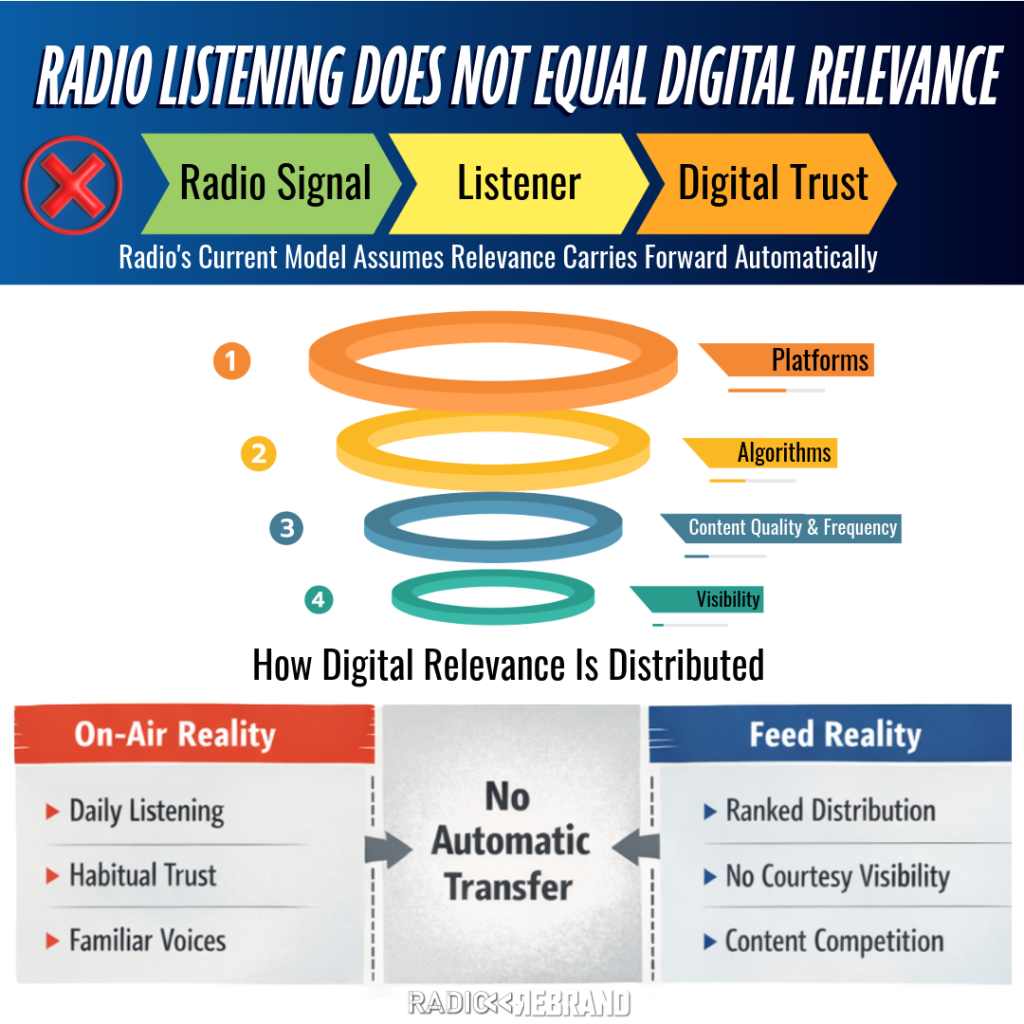
Radio does not respect its audience by ignoring everything that happens between listening moments. Instead, it assumes relevance earned on the air automatically carries forward into every other environment. In today’s media landscape, that assumption is no longer true.
Radio Confuses Signals With Brands
Radio still behaves as if it is primarily a signal. A signal exists only while it is being transmitted. The moment it stops, it disappears.
A brand works differently.
Brands persist across contexts. They reinforce trust even when the original experience is not happening. When radio forgets this distinction, it becomes invisible anywhere the signal is not present.
As a result, radio brands often vanish the moment a listener leaves the car. That disappearance is not neutral. It quietly erodes credibility.
How Digital Relevance Is Actually Distributed
Modern attention does not move linearly from one medium to another. Instead, it flows through ranked systems that decide what appears and what does not.
Social platforms and news feeds do not reward loyalty. They do not care how often someone listens. They surface content based on algorithms, content quality, frequency, and participation.
Listening is not an input.
Because of that, following a station does not guarantee visibility. Even engaged listeners may never see a brand in their feed if the content does not earn distribution. Over time, platforms respond exactly as designed. Weak content ranks lower. Infrequent content disappears entirely.
The Gap Between Listening and Seeing
On the air, radio still delivers powerful value. Daily listening builds habit. Familiar voices create trust. Emotional connection develops over time.
In feeds, the rules change.
Distribution is ranked. Courtesy visibility does not exist. Content competes equally with everything else in the environment.
Because of that, there is no automatic transfer between listening and digital presence.
That gap is where radio quietly loses ground. It becomes most visible when audiences or potential clients go looking digitally to assess credibility. In those moments, low video views, weak engagement, or an anemic following send a clear signal.
The signal is not about talent or trust on the air. It is about cultural position.
When a brand fails to show up in feeds at scale, it appears culturally behind other brands audiences already trust for relevance, context, and shared understanding. In ranked environments, absence is not neutral. It is comparative.
And comparison is how credibility is now judged.
What Digital Absence Communicates to Audiences and Advertisers
When a listener hears a station regularly but never sees it anywhere else, a conclusion forms. It is rarely spoken out loud, but it is consistently felt. It signals stagnation. It suggests the brand is not active in the same reality as its audience.
Advertisers notice this even faster than listeners do. In a brand driven media economy, invisibility is interpreted as irrelevance, regardless of ratings or legacy reach.
Reinforcement Is Not Interruption
Showing up in feeds is not about demanding attention. It is not about nagging audiences or chasing engagement for its own sake. Instead, it is about reinforcing legitimacy where legitimacy is constantly tested.
Radio already has advantages digital brands work years to earn. It has trust, habit, familiarity, and emotional connection. What it lacks is reinforcement between moments.
Respecting an audience does not mean disappearing between interactions. It means understanding that relevance must be continuously validated, not assumed.
Radio does not lose influence because it interrupts too much. Rather, it loses influence when it forgets that it is a brand, not just a signal.
And in ranked digital environments, only brands that show up are allowed to matter.
About the Author